- Sabine's Newsletter
- Posts
- A Moon Hotel, Graviton Ambitions, Space Junk, and Dimensions
A Moon Hotel, Graviton Ambitions, Space Junk, and Dimensions
This week’s science bits from SWTG

Marcus Gee-Lim
January 21, 2026
|


You Can Now Reserve a Hotel Room On the Moon

Artist’s impression of the moon hotel. Credits: GRU Space
The American startup GRU Space (Galactic Resource Utilization Space) wants to build a hotel on the moon and is now inviting interested guests to apply for a stay. For a deposit of $250,000+, you can get a chance to reserve a spot in one of the first rooms, which the company hopes to have up and running by 2032. In case that sounds sketchy, rest assured that you can ask for your money back in the first 30 days, minus a $1000 non-refundable application fee.
You can also now reserve a room in the hotel that I am totally planning to build on Pluto. You can get your deposit back at any time you want, minus a $1000 non-refundable application fee…
This week’s episode of Science News is about the dimensions of space. Why does space have 3 dimensions? Why not 2? Or 4? Or 7? It’s because physics wouldn’t work properly. Let’s take a look at the major reasons for why physics needs 3 dimensions.
First Ever Graviton Detector to be Built in the USA

Illustration of the graviton detector. Credit: I. Pikovski.
Physicists at the Stevens Institute of Technology in New Jersey and Yale University have teamed up to build the world’s first detector that has a reasonable chance to detect gravitons, the hypothetical quanta of gravity. The experiment would entail cooling a centimetre-sized drop of superfluid helium so much that the tiny bumps from gravitons could cause a measurable resonance. If successful, this experiment would establish that gravity really has quantum properties, settling a 90 year old debate, and without doubt winning a Nobel Prize. The plan has been supported with $1.3 million from the Keck Foundation. I talked about this idea here, but honestly didn’t expect it moving towards realization that quickly.
We’re running a super short survey to see if our newsletter ads are being noticed. It takes about 20 seconds and there's just a few easy questions.
Your feedback helps us make smarter, better ads.
More Space Junk Than Ever
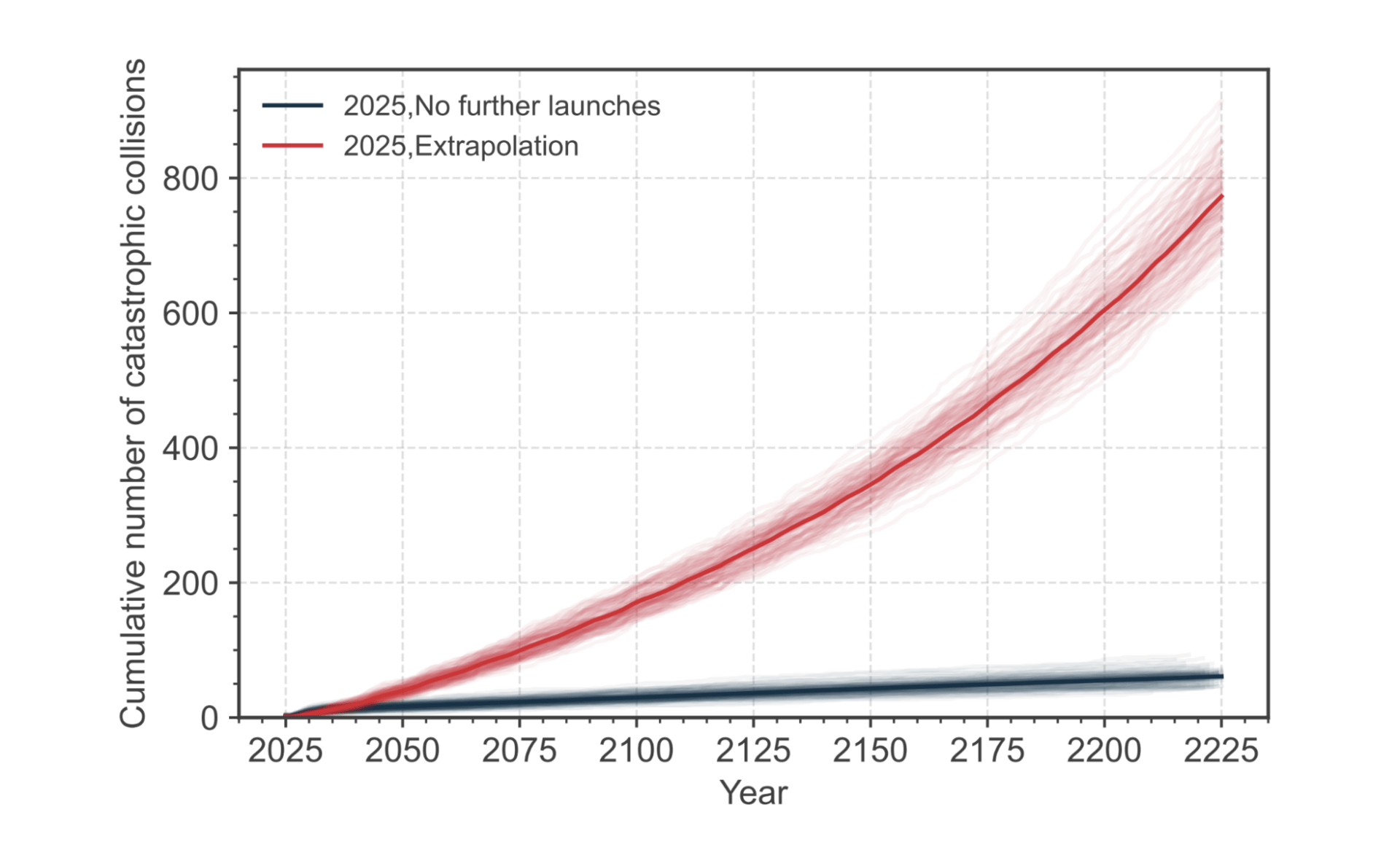
Figure: ESA
The European Space Agency (ESA) has updated their space environment report. The brief summary is that the number of pieces of debris is constantly increasing. There are now more than 50,000 objects larger than 10 centimetres in Earth orbit, and more than 140 million smaller than 1 centimetre. Their simulations predict that the number of catastrophic collisions in Earth’s orbit (collisions resulting in the total destruction of the colliding objects) will increase from near zero today to more than 100 per year by the end of the decade (see figure). ESA warns that the Kessler syndrome problem is now baked in, even if we stopped adding more stuff into orbit. The only way “to prevent this runaway chain reaction… from escalating and making certain orbits unusable,” ESA writes, will require “active debris removal”. Full report here.