- Sabine's Newsletter
- Posts
- Big Superpositions, AI Specialization, Quantum Computing Woes, and Geothermal Energy
Big Superpositions, AI Specialization, Quantum Computing Woes, and Geothermal Energy
This week’s science bits from SWTG

Marcus Gee-Lim
January 28, 2026
|


Quantum Weirdness Gets Bigger
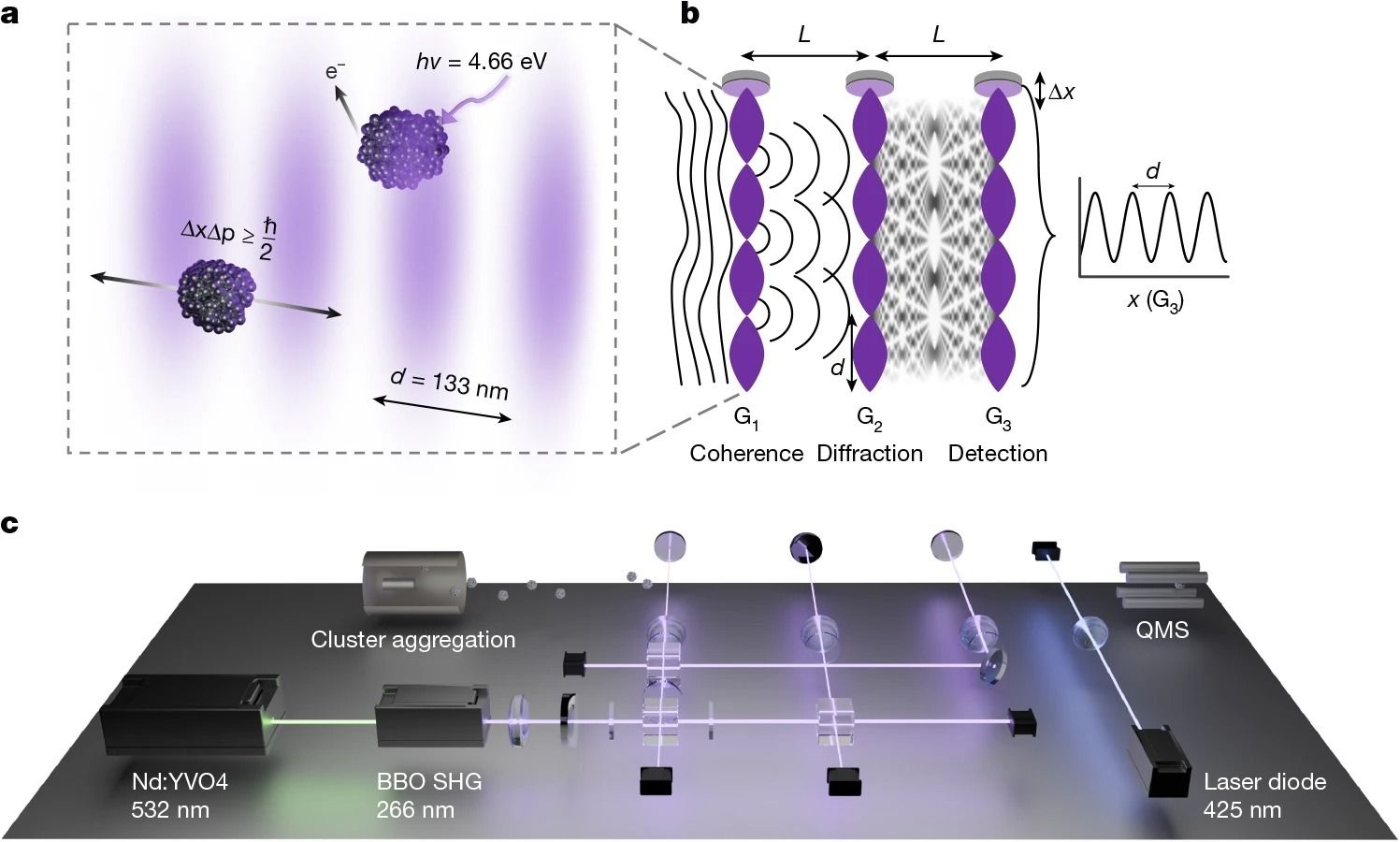
Figure: Pedalino et al, Nature 649, 866 (2026)
You might say quantum mechanics is already strange enough with particles acting like waves and being in two places at once and whatnot, but scientists just set a new record for how big this weirdness can get. In a new experiment that was just published in Nature, a group from Vienna managed to put sodium nanoparticles, each with more than 7,000 atoms, into superpositions using laser gratings. Then they proved that the particles could interfere with themselves, so they must have been in multiple places at once. These particles are about ten times heavier than the previously largest quantum object made to interfere with itself.
I find this an interesting experimental avenue because I believe that we will eventually see deviations from the predictions of quantum mechanics when objects become massive enough.
Paper here.
This week’s episode of Science News is about geothermal energy – using the heat from within the Earth to generate electricity. The technology has been around as a concept for decades at this point, but recently, geothermal technology has improved by leaps and bounds, and it could be poised to become a major source of renewable energy alongside solar and wind power. Not only this, the technology can also be used as energy storage. Let’s take a look.
AI Tools Benefit Research Specialization, Harm Breadth

Figure: A measure for the knowledge extent of scientists’ research inferred from their publications. Blue: Non-AI, Red: AI. Source: Hao et al, Nature (2026)
A group of AI researchers report that the increasing use of AI in scientific research is a double-edged sword. The authors trained a large language model on more than 40 million natural science papers published from 1980 until March 2025. They looked at three different “AI eras”: the early machine learning era (1980-2015), the more recent deep learning era (2016-2022), and the still ongoing era of large language models. Their analysis reveals that scientists who have used AI tools in any era publish roughly three times more papers, earn nearly five times more citations, and reach leadership roles about 1.4 years earlier than non-users. Yet at the collective level, AI adoption is linked to a 4.6% reduction in the diversity of scientific topics explored, and a 22% drop in how much researchers engage with each other’s ideas. Paper here. (ArXiv version here.)
The Gold standard for AI news

AI will eliminate 300 million jobs in the next 5 years.
Yours doesn't have to be one of them.
Here's how to future-proof your career:
Join the Superhuman AI newsletter - read by 1M+ professionals
Learn AI skills in 3 mins a day
Become the AI expert on your team
Another Use Case for Quantum Computers Evaporates

Quantum computers are great, they say, because they can solve problems too tough for regular computers, like simulating super-complex molecules in nature. One big example has been a molecule called the “FeMo-cofactor,” which plays a major role in bacteria that enrich soil with nitrogen. This process feeds plants and, ultimately, us. Understanding this molecule could lead to better fertilizers and make a major impact on feeding the world. And while we have the equations that describe the properties of the molecule, we can’t solve them on a conventional computer, they are just too difficult — a quantum computer must do it, or so the story goes.
Well, in a new preprint that just appeared on the arXiv, a team from Caltech managed to calculate the ground state energy of the molecule to stunning precision with a conventional computer cluster. This in itself isn’t going to change the world, but it illustrates that finding a practical advantage for quantum computers is tough. Paper here.